Evaluating the Calligraphy Practice Paper KDP Interior for Self-Publishing
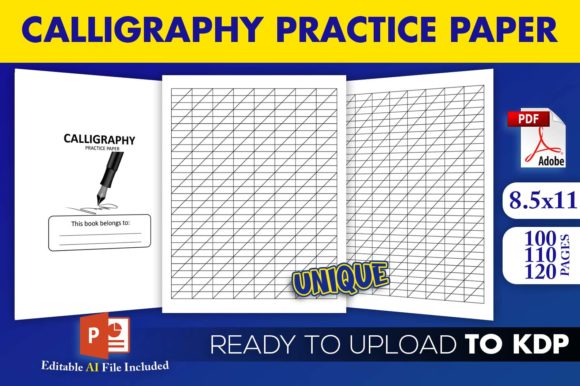
For self-publishers and low-content book creators, the quality of interior files often dictates the long-term viability of a product. The Calligraphy Practice Paper KDP Interior represents a specific category of functional design assets aimed at streamlining the production of handwriting workbooks. Unlike generic lined paper, calligraphy guides require precise spacing, consistent baseline grids, and appropriate opacity to be genuinely useful to practitioners. This resource package addresses those technical requirements by providing pre-formatted interiors alongside editable source files, allowing publishers to validate their products before committing to print or digital distribution.
The primary value proposition of this asset lies in its balance between ready-to-use convenience and necessary customization. While many KDP templates offer only static PDFs, the inclusion of an editable PowerPoint (PPTX) source file significantly alters the workflow. This flexibility allows creators to adjust guide heights, modify margins for binding, or add instructional headers without needing advanced graphic design software like Adobe InDesign. For entrepreneurs managing multiple niche titles, this adaptability reduces the time spent on formatting and increases the focus on market research and keyword optimization.
Technical Specifications and File Integrity
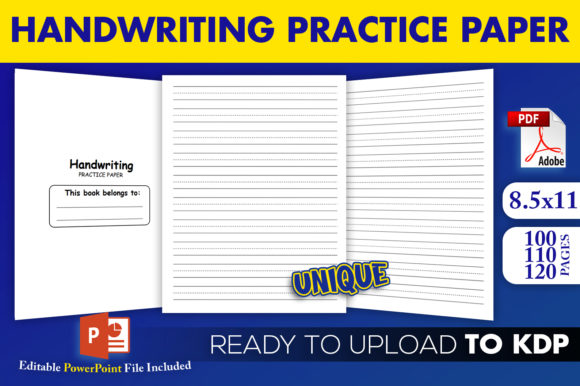
Reliability is the most critical factor when selecting KDP interiors. A file that looks correct on a screen but fails during Amazon’s automated review process results in lost time and potential account warnings. This Calligraphy Practice Paper KDP Interior has been explicitly tested for KDP compliance, addressing common rejection triggers such as margin errors, bleed issues, and color space mismatches. The trim size is set to the industry-standard 8.5×11 inches, which provides ample workspace for adult learners and students practicing lettering drills.
The download includes three distinct PDF variations with page counts of 100, 110, and 120 pages. This variety serves a strategic purpose beyond simple quantity options. Different page counts affect the spine width calculation and the overall perceived value of the book. A 100-page workbook may serve as an introductory starter kit, while a 120-page version justifies a higher price point and suggests comprehensive practice material. Having these pre-calculated versions eliminates the risk of manual pagination errors, ensuring that the gutter margins remain consistent across all variants.
High-resolution output is non-negotiable for calligraphy guides. Blurry or pixelated guidelines frustrate users and lead to negative reviews. The interiors provided maintain sharp vector-like clarity at print resolution, ensuring that the slant lines, baselines, and x-height markers remain crisp. This visual precision is essential because calligraphy practice relies entirely on the user's ability to see and replicate exact angles and proportions relative to the printed grid.
The Strategic Value of Editable Source Files
While the ready-to-upload PDFs offer immediate utility, the editable PPTX source file is arguably the most significant component for serious publishers. PowerPoint is a ubiquitous tool with a shallow learning curve compared to professional layout software. This accessibility means that even creators without formal design training can make meaningful modifications. Practical applications of the editable file include:
- Branding Integration: Adding logos, website URLs, or QR codes to the footer or header to drive traffic to external platforms or email lists.
- Niche Customization: Adjusting the guideline spacing to accommodate specific scripts such as Copperplate, Gothic, or modern brush lettering, rather than being locked into a single generic style.
- Instructional Content: Inserting tip pages, warm-up exercises, or reference charts between practice sheets to transform a simple notebook into a guided educational resource.
- Cover Coordination: Matching the interior aesthetic to the cover design by tweaking line weights or grayscale values for visual consistency.
This level of control supports differentiation in a saturated market. Rather than publishing identical interiors to competitors using the same static templates, publishers can create unique value propositions through minor but impactful customizations.
Practical Usability and Audience Fit
Understanding who benefits from this Calligraphy Practice Paper KDP Interior helps determine its fit for your specific publishing portfolio. The asset is particularly well-suited for educators creating supplementary classroom materials, homeschooling parents developing penmanship curricula, and hobbyist authors sharing personal lettering methods. It also serves freelancers and virtual assistants looking to diversify income streams with low-maintenance digital products.
However, usability extends beyond the publisher to the end-user. Effective calligraphy paper must account for ink bleed-through and erasure durability. While the digital file cannot control the physical paper stock used by KDP, the design can mitigate these issues. The high-resolution lines in this template are typically designed with optimal contrast—dark enough to be visible but light enough not to distract from the user's ink work. Publishers should always order a proof copy to test how the guidelines interact with various markers, dip pens, and fountain pens on standard 55# or 60# white paper.
For marketers and bloggers, this interior serves as an excellent lead magnet or bonus content. A branded calligraphy workbook can be offered in exchange for email signups, providing tangible value that reinforces authority in creative niches. Because the file is editable, removing KDP-specific elements and resizing for digital tablet use (such as GoodNotes or Notability) is a feasible secondary application, extending the asset's ROI beyond physical print sales.
Realistic Limitations and Considerations
Despite its strengths, prospective users should approach this Calligraphy Practice Paper KDP Interior with realistic expectations. No template guarantees sales; success depends on keyword research, cover design, and marketing efforts. Additionally, while PowerPoint is versatile, it has typographic limitations compared to dedicated layout programs. Complex text wrapping or advanced layer management may be cumbersome if extensive instructional content is added.
Publishers must also verify licensing terms. Most KDP interior resources allow for commercial use in published books but prohibit reselling the raw template files themselves. Ensuring compliance protects your business from intellectual property disputes. Furthermore, trends in calligraphy evolve. What is considered standard guideline spacing today may shift as new lettering styles gain popularity. The editable nature of this file future-proofs the investment, but it requires the publisher to stay informed about current lettering standards to keep products relevant.
Workflow Integration and Quality Assurance
Integrating this asset into a publishing workflow requires a systematic quality assurance process. Even though the files are labeled as "tested on KDP," platform specifications change periodically. Before uploading, always run the PDF through the latest KDP Previewer tool. Check specifically for:
- Gutter Safety: Ensure that the inner margin accounts for the page count. A 120-page book requires a wider gutter than a 100-page book to prevent guidelines from disappearing into the binding.
- Bleed Verification: If any decorative elements extend to the edge, confirm that bleed settings match the file dimensions exactly.
- Grayscale Consistency: Verify that all elements are in true black or grayscale to avoid unexpected color printing charges or conversion artifacts.
From a production standpoint, the separation of page count variants simplifies inventory management. Publishers can maintain a master PPTX file for edits and export specific PDF versions as needed. This modular approach prevents version control issues where changes made to one file size might accidentally be omitted from another. Maintaining organized source files ensures that updates or corrections can be implemented efficiently across the entire product line.
Ultimately, the Calligraphy Practice Paper KDP Interior functions as a foundational infrastructure tool. It removes the technical barrier to entry for creating professional-grade practice books, allowing creators to focus on audience building and content strategy. Its combination of tested reliability, high-resolution output, and editable flexibility makes it a pragmatic choice for publishers who view low-content books as a scalable business rather than a passive side project. By leveraging the editable components to create differentiated products and adhering to rigorous quality checks, this asset can support sustainable growth in the competitive self-publishing landscape.