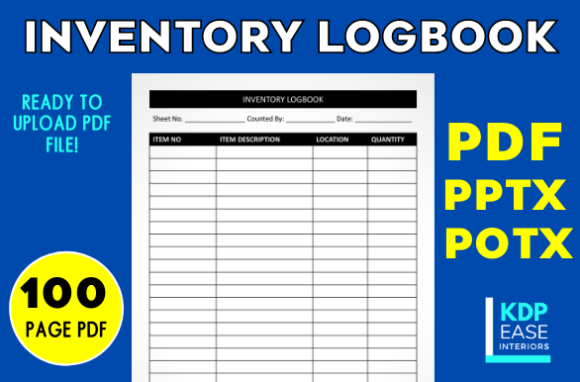
Inventory Log Sheet Logbook Upload Ready: Evaluating Format, Utility, and KDP Viability
Selecting the right interior template for a low-content book requires balancing technical compliance with practical utility. For publishers targeting the business and organization niche, an Inventory Log Sheet Logbook Upload Ready package offers a specific solution designed to streamline the production process. Unlike generic notebook templates, this resource focuses on functional data entry for stock tracking, asset management, and retail organization. Understanding the distinct characteristics of this pre-formatted 100-page PDF, along with its accompanying PowerPoint source files, is essential for determining whether it aligns with your publishing strategy or if alternative formats would better serve your target audience.
Defining the Upload-Ready Specification
The term "upload ready" in the context of Kindle Direct Publishing (KDP) and other print-on-demand platforms refers to more than just file compatibility; it implies adherence to strict manufacturing tolerances. This specific Inventory Log Sheet Logbook Upload Ready asset is formatted for 8.5 x 11-inch paper with no bleed. The "no bleed" designation is a critical technical distinction. It means all content, including lines, headers, and table borders, sits safely within the margin zone, typically at least 0.375 inches from the trim edge. This differs significantly from full-bleed designs where graphics extend to the paper's edge.
For inventory logs, a no-bleed layout is often superior to full-bleed alternatives. Functional logbooks require precise writing space, and users generally prefer margins that prevent text from being lost in the binding gutter or trimmed during manufacturing. The 100-page count (resulting in approximately 60 physical sheets due to double-sided printing considerations in some contexts, though standard KDP pagination counts individual sides) provides substantial capacity without making the spine too thick for cost-effective shipping. When evaluating this product, verify that the safe zones accommodate the specific binding type you intend to use, as paperback glue bindings require different inner margins than spiral-bound options.
Comparing Source File Formats: POTX vs. PPTX
A significant differentiator of this package is the inclusion of both POTX and PPTX source files alongside the final PDF. Understanding the utility of each format helps in assessing long-term value compared to static-only alternatives.
- POTX (PowerPoint Template): This file serves as a master blueprint. It contains predefined layouts, color schemes, and placeholder structures but does not save changes to the original file by default. Using a POTX ensures consistency across multiple projects and prevents accidental overwriting of the core design. It is ideal for publishers who plan to create variations of the inventory log for different niches (e.g., retail vs. warehouse).
- PPTX (Standard Presentation): This is the working file. It allows for direct manipulation of table columns, header text, and row heights. Compared to Adobe InDesign or Canva templates, PowerPoint offers a lower learning curve for users already familiar with Microsoft Office. However, it lacks advanced typographic controls and vector precision.
- PDF Output: The provided PDF is the flattened, print-ready result. While convenient, relying solely on a PDF limits customization. If you need to adjust column widths for specific inventory types (e.g., wider SKU columns vs. wider description columns), the source files are mandatory.
When comparing this to competitors offering only Canva links or flattened PDFs, the inclusion of native PowerPoint files offers greater software independence. However, professional designers accustomed to industry-standard layout software may find PowerPoint’s grid snapping and alignment tools limiting for complex tabular data.
Evaluating Content Utility Against Market Needs
The profitability of low-content books hinges on solving a specific user problem. An Inventory Log Sheet Logbook Upload Ready template must offer more than blank lines to compete in an evergreen market. Buyers in this niche are typically small business owners, warehouse managers, or resellers who need immediate organizational structure. When assessing this 100-page logbook, consider how its internal layout compares to free printable alternatives or digital spreadsheet solutions.
Physical logbooks retain relevance despite digital alternatives because they offer battery-free reliability, quick access in environments where devices are prohibited or impractical, and tangible audit trails. A strong template includes dedicated fields for SKUs, unit costs, reorder points, supplier information, and date stamps. If the template provides only generic "Item" and "Quantity" columns, it may fail to meet the needs of serious users who require comprehensive tracking. Compare the column density and header clarity against top-selling organic results in the category. High-value templates often include reference pages, index sections, or yearly summaries that elevate the perceived value beyond a simple pad of paper.
Tradeoffs: Pre-Made Templates vs. Custom Design
Choosing an Inventory Log Sheet Logbook Upload Ready resource involves weighing speed against uniqueness. Pre-made templates significantly reduce time-to-market, allowing publishers to test keywords and niches rapidly. This is particularly advantageous for those building a portfolio of evergreen assets where volume and keyword coverage drive cumulative income.
However, the tradeoff is potential market saturation. If hundreds of sellers utilize the exact same 100-page layout, differentiation becomes difficult. Custom design allows for unique selling propositions, such as specialized industry terminology or proprietary tracking methods, but requires significant upfront investment in design skills and software. For new entrants or those validating a niche, the pre-made option reduces risk. For established publishers seeking to dominate a specific sub-niche, using the provided PPTX source to heavily modify the layout—changing fonts, adjusting table structures, and adding custom branding—is necessary to avoid competing solely on price.
Technical Considerations for Print Quality
Inventory logs are functional documents where readability is paramount. When evaluating this 8.5 x 11 no-bleed template, scrutinize the line weight and contrast. Lines that are too thin may disappear during the printing process, while lines that are too thick can make handwriting difficult. Standard practice suggests line weights between 0.5pt and 0.75pt for optimal reproduction on standard KDP white paper.
Additionally, consider the opacity of the paper. Standard 55# (90 GSM) white paper used in many POD services has limited opacity. Double-sided printing of dense tables can lead to bleed-through, rendering the reverse side unusable. Some high-quality inventory logbooks intentionally leave the back of each sheet blank or place lighter content on alternating pages to mitigate this. If the provided template utilizes every page for dense data entry, user reviews may suffer due to paper quality issues inherent to the platform rather than the design itself. Testing a proof copy is always recommended before listing to ensure the 100-page configuration performs well physically.
Strategic Fit and Decision Factors
Determining whether this specific Inventory Log Sheet Logbook Upload Ready package is the right choice depends on your current resources and business goals. It is best suited for:
- Publishers with Limited Design Skills: The PowerPoint source files bridge the gap between needing customization and lacking professional design software proficiency.
- Niche Testers: Those looking to validate demand for specific inventory types (e.g., "Boutique Clothing Inventory" vs. "Auto Parts Stock") can quickly adapt the template without starting from scratch.
- Budget-Conscious Entrants: Compared to hiring a designer or purchasing expensive software subscriptions, this asset provides a professional baseline at a lower entry cost.
Conversely, this option may be insufficient for publishers targeting premium markets or highly specialized industries requiring regulatory compliance formatting. If your research indicates that successful books in your target niche feature complex indexing, carbon-copy simulation, or non-standard trim sizes, a standard 8.5 x 11 upload-ready template may require more modification than creating a custom solution would.
Ensuring Long-Term Evergreen Performance
While inventory logbooks are considered evergreen, maintaining sales requires ongoing optimization. The initial upload is merely the starting point. Success in this category correlates strongly with cover design quality and keyword relevance. Even the most perfectly formatted interior will fail if the cover does not signal professionalism and utility to the buyer. Use the source files to create series variations, testing different color schemes and title phrasings to capture adjacent search terms.
Furthermore, monitor customer feedback regarding the layout's functionality. Reviews mentioning "columns too narrow" or "not enough space for notes" provide direct instructions for updating the PPTX source file. The ability to iterate on the design based on real-world usage data is the primary advantage of owning editable source files versus static PDFs. By treating the Inventory Log Sheet Logbook Upload Ready package as a living foundation rather than a finished product, publishers can build sustainable assets that continue to generate income through seasonal fluctuations and market evolution.