Streamline Academic Writing with a KDP Interior Essay Planner
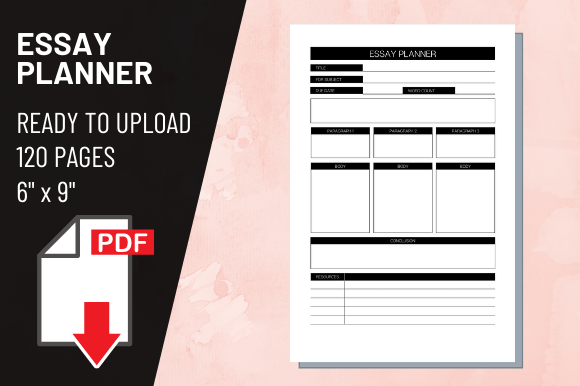
For independent publishers and academic resource creators, finding the right balance between functionality and production quality is essential. A KDP Interior Essay Planner serves as a specialized tool designed to bridge the gap between abstract thought and structured writing. Unlike generic notebooks or standard lined journals, this specific interior layout is engineered to support the cognitive load of essay composition, research organization, and critical thinking. When you utilize a pre-formatted 6″ x 9″ PDF file at 300 dpi, you are not merely uploading a document; you are providing a tangible solution for students, researchers, and lifelong learners who struggle to organize their arguments effectively.
Addressing the Challenges of Structured Writing
The primary audience for an essay planner faces distinct hurdles that standard stationery cannot solve. Adults returning to education, graduate students managing thesis work, and professionals writing for publication often experience friction during the drafting phase. The blank page syndrome is real, but so is the disorganization of ideas. Common challenges include:
- Fragmented Research: Notes are scattered across digital apps, sticky notes, and random notebooks, making synthesis difficult.
- Weak Thesis Development: Writers often jump into drafting without a solid central argument, leading to repetitive rewrites.
- Citation Mismanagement: Losing track of sources during the brainstorming phase leads to academic integrity issues later.
- Structural Incoherence: Without a visual guide, paragraphs often lack transition and logical flow.
A dedicated Essay planner KDP interior addresses these pain points by imposing a helpful structure without being restrictive. It transforms the chaotic process of ideation into a linear, manageable workflow. By offering a physical space dedicated to specific stages of writing, the planner reduces cognitive fatigue and allows the user to focus on content rather than formatting.
How the 6x9 Format Enhances Utility
The decision to offer this resource in a 6″ x 9″ trim size is strategic. For adult users seeking practical answers, portability equals utility. This dimension fits comfortably in a bag alongside textbooks or laptops, encouraging consistent use. Unlike larger 8.5″ x 11″ formats which can feel like homework assignments, the 6″ x 9″ profile feels like a personal companion. It is intimate enough for private reflection yet spacious enough to accommodate detailed outlining.
Furthermore, the technical specifications of this package ensure professional results. The included high-quality PDF file is rendered at 300 dpi, ensuring crisp lines and legible text even on standard KDP paper stock. The "no bleed" configuration simplifies the publishing process significantly. Creators do not need to worry about margin shifts or content being trimmed during binding. This 120-page count provides substantial value—enough room for multiple essays or a full semester of planning—without creating a spine that is too thick for comfortable handling.
Practical Applications and User Outcomes
Implementing a KDP Interior Essay Planner into a product lineup or personal workflow yields measurable improvements in writing efficiency. The interior is typically segmented to guide the user through the lifecycle of an essay. Practical applications include:
Ideation and Brainstorming Zones
Rather than unlined blank space, effective planners provide prompted areas for mind mapping or bullet journaling. This encourages non-linear thinking before forcing structure. Users can dump raw ideas safely before refining them.
Thesis Statement Workshops
Dedicated sections for drafting and redrafting thesis statements help writers crystallize their main argument. Seeing previous iterations on paper helps adults recognize the evolution of their thought process, leading to stronger final drafts.
Evidence Tracking Matrices
One of the most valuable features in an Essay planner KDP interior is the source tracker. Tables designed to link quotes, paraphrases, and page numbers directly to specific arguments prevent the dreaded "where did I read that?" moment. This is particularly useful for adult learners balancing research with full-time careers.
Outline Scaffolding
Structured outline templates move beyond simple Roman numerals. They prompt users to consider topic sentences, supporting evidence, and concluding thoughts for each paragraph individually. This granular approach ensures that every section of the essay serves the central thesis.
Tailoring the Experience for Different Users
While the core function remains consistent, different demographics leverage the KDP Interior Essay Planner in unique ways. Understanding these variations helps in marketing and further product development.
University Students: For this group, the planner is a survival tool. They prioritize speed and grade optimization. They use the citation trackers rigorously and rely on the outline scaffolds to meet word counts without fluff. The 120-page length allows them to plan 4-6 major papers per book.
Adult Learners and Professionals: These users often write less frequently but with higher stakes. They appreciate the 6″ x 9″ size for discretion and portability. Their usage focuses more on clarity of communication and persuasive argumentation rather than academic grading criteria. They may use the brainstorming sections more extensively to untangle complex professional problems.
Creative Non-Fiction Writers: Even outside academia, essayists use these planners to structure narratives. They adapt the evidence tracking sections for anecdotal references and use the thesis workshops to find the emotional core of their stories.
Considerations for Implementation and Quality
When utilizing this ready-to-upload package, there are several factors to ensure the best possible outcome. Although the file is print-ready, understanding the nuances of KDP printing enhances the end-user experience.
- Paper Choice Matters: Since this is a no-bleed 300 dpi PDF, it prints excellently on both white and cream paper. However, for an essay planner where readability is paramount, white paper often provides better contrast for detailed tables and small text.
- Cover Design Alignment: Ensure your cover design reflects the organized nature of the interior. A cluttered cover contradicts the promise of an organized essay planner. Minimalist, typography-driven designs tend to convert best for this niche.
- Keyword Optimization: When listing this product, remember that buyers search for solutions. Terms like "academic writing organizer," "research notebook," and "thesis planning journal" are semantically relevant to KDP Interior Essay Planner and should be integrated naturally.
- Preview Verification: Always download the proof copy or use the online previewer to check margins. While the no-bleed setting is safe, verifying that the inner gutter margin allows for easy writing near the spine is crucial for user satisfaction in a 6″ x 9″ format.
Maximizing Value Through Organization
Ultimately, the success of an essay planner lies in its ability to reduce anxiety. Writing is an intellectually demanding task, and adults seeking resources are often looking for permission to slow down and think. A well-designed Essay planner KDP interior provides that permission physically. It validates the planning stage as equal in importance to the drafting stage.
By providing a 120-page, high-resolution, perfectly sized template, you remove the barrier of creation. Users do not have to draw their own tables or rule their own lines. They simply open the book and begin the work of thinking. This immediate utility is what separates a successful low-content book from a generic notebook. Whether used for a doctoral dissertation, a professional white paper, or a personal blog post, the structured environment fosters better outcomes. The 300 dpi resolution ensures that every prompt and line is sharp, reinforcing the professional quality of the tool. In a market saturated with blank pages, a purpose-built interior offers a clear, actionable path to better writing.