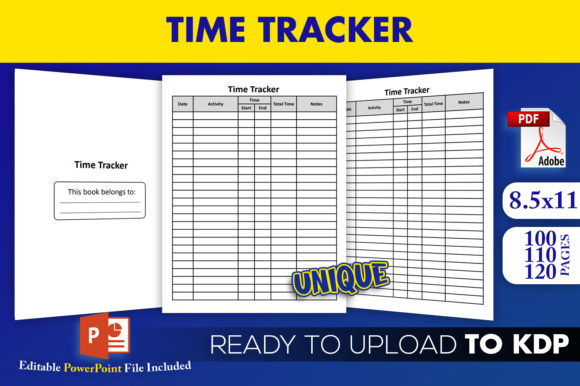
Time Tracker Logbook KDP Interior: Strategic Asset for Publishers and Professionals
Acquiring a high-quality Time Tracker Logbook KDP Interior is more than a simple file download; it is a strategic acquisition for low-content publishers and productivity-focused creators. This specific asset package provides the foundational infrastructure needed to launch or expand a portfolio in the competitive time management niche. The download includes an editable source file in PowerPoint (PPTX) format alongside three distinct PDF interiors ready for immediate upload to Amazon KDP or professional printing. These files have been rigorously tested on KDP to ensure compliance with current publishing standards, eliminating technical guesswork. Available in a standard 8.5×11 trim size, the package offers versatility through three different page counts: 100, 110, and 120 pages. All interiors are rendered in high resolution, ensuring crisp lines and professional readability that meets the expectations of discerning customers.
The Strategic Value of Editable Source Files
The inclusion of an editable PowerPoint source file distinguishes this Time Tracker Logbook KDP Interior from static, non-modifiable templates. For entrepreneurs and publishers, editability is synonymous with market adaptability. A static PDF limits you to a single product iteration, whereas a PPTX file allows for rapid customization based on real-time market feedback. You can adjust column widths, modify header fonts, add branding elements, or restructure tracking categories to target specific sub-niches such as freelance billing, student study logs, or employee timesheets.
This flexibility supports better decision-making regarding product positioning. If analytics indicate that your audience prefers weekly summaries over daily granular tracking, you can pivot your interior design without commissioning new artwork or learning complex vector software. The ability to manipulate the source file transforms a generic logbook into a specialized tool, increasing perceived value and reducing direct competition with saturated generalist keywords. Furthermore, having the source file secures long-term operational independence, ensuring you are not reliant on third-party designers for minor updates or seasonal variations.
Leveraging Multiple Page Counts for Portfolio Diversification
The provision of 100, 110, and 120-page variants serves a distinct strategic purpose beyond mere convenience. In the print-on-demand ecosystem, offering multiple sizes allows for comprehensive market testing and price point optimization. Different customer segments have different utility thresholds; a freelancer may prefer a slimmer 100-page book for quarterly tracking, while an educator or small business owner might require the density of a 120-page volume for annual planning.
- Price Elasticity Testing: Use the varying page counts to test price sensitivity. Determine if customers are willing to pay a premium for higher page density or if they prefer a lower entry price point.
- Keyword Targeting: Assign specific long-tail keywords to each variant. The 100-page version might target "quarterly time tracker," while the 120-page version targets "annual work log."
- Risk Mitigation: Diversifying your SKU count within a single niche reduces reliance on a single product's performance. If one variant underperforms, others may compensate based on seasonal demand shifts.
By utilizing all three provided interiors, you maximize the return on investment from a single design concept while signaling to the algorithm that your brand offers comprehensive solutions within the time tracking category.
Operational Readiness and Technical Compliance
One of the most significant friction points in KDP publishing is technical rejection due to margin errors, bleed issues, or resolution failures. This Time Tracker Logbook KDP Interior addresses these risks proactively. The statement that files have been tested on KDP is a critical quality assurance indicator. It implies that margins account for binding gutters, safe zones are respected, and resolution meets the 300 DPI threshold required for sharp printing. For professionals and decision-makers managing multiple titles, this pre-validation saves hours of troubleshooting and prevents the accumulation of negative reviews caused by poor print quality.
The 8.5×11 trim size is strategically selected for this niche. Unlike smaller journals, time trackers often require horizontal space for detailed entries, project codes, and calculation columns. This larger format accommodates functional layouts that smaller sizes cannot support without cramping. When evaluating this asset, consider how the physical dimensions align with user behavior. Time tracking is often a desk-based activity where users need ample writing space; the 8.5×11 format supports this use case better than portable 6x9 alternatives, positioning the product as a serious operational tool rather than a casual notebook.
Intentional Use Cases for Productivity and Business Operations
To derive maximum value from this Time Tracker Logbook KDP Interior, users must move beyond viewing it as a passive recording device. Effective implementation requires integrating the logbook into broader workflows. For freelancers and consultants, the logbook serves as a primary source document for invoicing and tax preparation. The structured layout facilitates accurate billable hour capture, directly impacting revenue recognition and financial compliance. For educators and students, it functions as a metacognitive tool, making study patterns visible and enabling data-driven adjustments to learning schedules.
Small business owners can utilize these interiors to audit operational efficiency. By tracking time allocation across departments or projects, leaders can identify bottlenecks and resource misalignments. The high-resolution interiors ensure that even dense data entry remains legible, which is essential when reviewing historical logs for trend analysis. When marketing this product or using it personally, emphasize the connection between consistent tracking and strategic insight. The logbook is not merely about recording what was done; it is about generating the data necessary to decide what should be done next.
Risks of Unstructured Tracking and How to Mitigate Them
While the Time Tracker Logbook KDP Interior provides excellent structural support, relying on it without clear goals can lead to counterproductive outcomes. A common risk is "tracking fatigue," where the act of logging becomes a burden that detracts from actual work. This occurs when the interior design or usage protocol is too granular for the user's needs. Because this asset includes editable source files, publishers should consider creating guidance pages or introductory sections that help users define their tracking parameters before they begin.
Another risk is data isolation. A physical logbook does not automatically integrate with digital project management tools. Users must understand that this analog tool serves as a capture mechanism, not necessarily a complete system. Strategic advice accompanying the product should encourage periodic review cycles—weekly or monthly audits where logged data is synthesized into actionable insights. Without this synthesis step, the logbook becomes a graveyard of unused information. Publishers can differentiate their offering by including prompts or reflection sections within the editable PPTX template, transforming the product from a simple ledger into a guided productivity system.
Evaluating Quality and Long-Term Viability
Before integrating this Time Tracker Logbook KDP Interior into your catalog or workflow, conduct a thorough evaluation of its alignment with your objectives. High resolution is non-negotiable; blurry lines or pixelated text destroy credibility instantly. Verify that the editable elements in the PowerPoint file are truly accessible and not flattened images masquerading as editable layers. Test the print preview yourself, even if the files are marketed as pre-tested, to ensure compatibility with your specific KDP account settings and regional printing facilities.
Consider the longevity of the design. Timeless, minimalist aesthetics tend to outperform trendy designs in the productivity niche because they appeal to a broader demographic and remain relevant across years. Assess whether the interior layout allows for future expansion or series development. Can you create complementary products like project planners or goal-setting journals that share the same visual language? Building a cohesive brand ecosystem increases customer lifetime value and creates cross-selling opportunities that standalone products cannot achieve.
Making Informed Decisions for Sustainable Growth
The decision to acquire and utilize a Time Tracker Logbook KDP Interior should be grounded in a clear understanding of both market demand and personal operational needs. For publishers, the combination of tested PDFs and editable source files offers a balanced approach to speed-to-market and long-term differentiation. The variety in page counts enables sophisticated testing strategies that inform future product development. For end-users, the 8.5×11 high-resolution format supports serious productivity work that smaller, lower-quality alternatives cannot sustain.
Success with this asset depends on intentional application. Avoid the trap of treating time tracking as an end in itself. Instead, position the logbook as a diagnostic instrument that informs better planning, pricing, and prioritization decisions. Whether you are creating products for others or optimizing your own professional workflow, the value lies not in the paper or the pixels, but in the clarity that structured tracking brings to complex activities. By approaching this Time Tracker Logbook KDP Interior with strategic intent, you transform a simple commodity into a powerful lever for achieving measurable results and sustainable growth in an increasingly distracted world.