Implementing 150 Sudoku Puzzles for Kids Vol.10 in Educational and Home Environments
Structural Specifications and Print Optimization
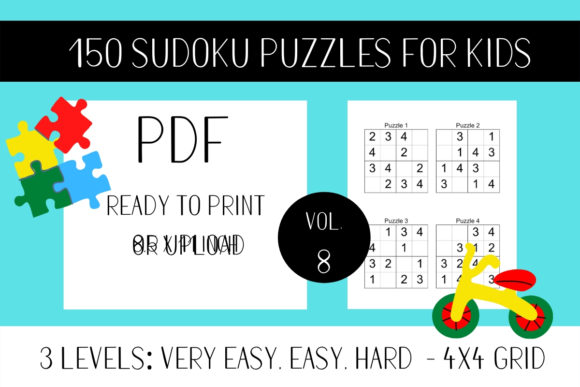
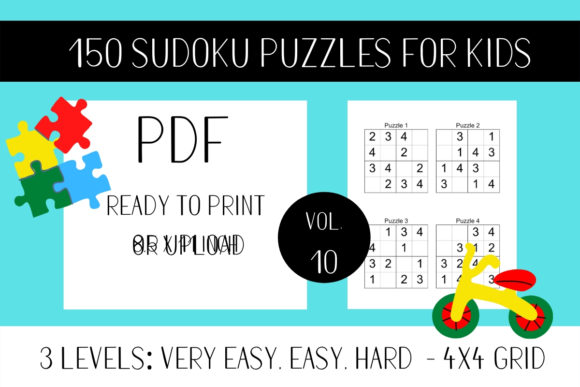
When selecting cognitive development materials for children, the physical architecture of the resource is as critical as the content itself. 150 Sudoku Puzzles for Kids Vol.10 is engineered with specific dimensional standards that cater to both institutional and domestic printing capabilities. The document is formatted strictly for 8.5″ x 11″ paper, which aligns with standard letter-size printing protocols used in North American schools, libraries, and home offices. This sizing eliminates the need for scaling adjustments or tiling, ensuring that margins remain consistent and no content is truncated during the printing process.
The PDF format serves as a universal delivery mechanism for this ready-to-print sudoku puzzle book for kids. Unlike proprietary software or app-based puzzles, a static PDF ensures compatibility across all operating systems and devices without requiring internet connectivity after the initial download. For educators managing classroom sets or parents creating travel activity packs, this digital-first approach allows for on-demand reproduction. Users can print the entire 63-page volume at once or select specific sections based on immediate needs, reducing paper waste and storage requirements associated with pre-bound workbooks.
Grid Density and Layout Efficiency
Efficiency in layout design directly impacts user engagement and resource management. This volume utilizes a four-puzzles-per-page configuration, resulting in a compact yet spacious presentation. With 4 x 4 grids being significantly smaller than traditional 9 x 9 layouts, placing four units on a single sheet maintains ample white space. This negative space is not merely aesthetic; it provides necessary room for young learners to write numbers clearly, make annotations, and erase mistakes without visual clutter. The density strikes a balance between maximizing paper usage and preventing cognitive overload through overcrowding.
Furthermore, the inclusion of four sudoku answers per page streamlines the verification workflow. In many commercial puzzle books, solutions are relegated to the back of the volume or a separate section, forcing users to flip back and forth repeatedly. By integrating the answer key directly onto the same page as the puzzles, 150 Sudoku Puzzles for Kids Vol.10 facilitates immediate feedback loops. This proximity supports self-directed learning, allowing children to validate their logic instantly, which reinforces neural pathways associated with problem-solving and error correction.
Cognitive Scaffolding Through Tiered Difficulty
Effective educational tools must accommodate varying developmental stages within a single cohort. The three difficulty levels embedded in this collection serve as a scaffolding mechanism for logical reasoning skills. The 4 x 4 grid structure acts as an accessible entry point for early learners who may find standard Sudoku intimidating. By reducing the variable set to numbers one through four, the cognitive load is managed effectively, allowing children to focus purely on the mechanics of row, column, and box constraints rather than arithmetic or complex pattern recognition.
- Level 1 (Introduction): Features maximum pre-filled cells to demonstrate grid logic and build confidence through quick wins.
- Level 2 (Progression): Reduces given clues incrementally, requiring users to hold multiple possibilities in working memory.
- Level 3 (Mastery): Presents minimal starting information, demanding advanced deduction strategies and sustained attention.
This graduated progression is essential for maintaining flow state. If a puzzle is too easy, boredom ensues; if it is too hard, anxiety blocks learning. The tiered system within 150 Sudoku Puzzles for Kids Vol.10 allows educators and parents to differentiate instruction seamlessly. A teacher can assign Level 1 to students needing foundational support while simultaneously challenging advanced learners with Level 3 grids, all using the same printed material. This versatility makes the PDF particularly valuable in mixed-ability classrooms, homeschooling environments, and tutoring sessions where individualized pacing is paramount.
Developing Executive Function Skills
Beyond simple entertainment, these puzzles function as targeted exercises for executive function. Solving a 4 x 4 Sudoku requires inhibition (resisting the urge to guess), cognitive flexibility (shifting strategies when stuck), and working memory (tracking potential number placements). Research in child development suggests that regular engagement with logic puzzles correlates with improved academic performance in mathematics and reading comprehension. The structured nature of the 63-page book provides a consistent routine for practicing these skills, transforming abstract cognitive training into a tangible, enjoyable daily habit.
Practical Applications Across Diverse Settings
The utility of a ready-to-print sudoku PDF extends far beyond solitary play. Professionals and caregivers leverage this type of resource in various operational contexts where structured, screen-free engagement is required. Understanding these use cases helps maximize the return on investment for the digital file.
Classroom Management and Supplemental Curriculum
For educators, 150 Sudoku Puzzles for Kids Vol.10 serves as a high-value transitional tool. The four-puzzle layout allows teachers to cut pages into quarters, creating individual task cards for math centers, morning work, or quiet time activities. Because the answers are included on the page, peer-review systems can be implemented where students check each other's work, fostering collaborative learning and communication skills. Additionally, the logic-based nature of Sudoku aligns with Common Core standards for mathematical practice, specifically regarding making sense of problems and persevering in solving them. Teachers can integrate these puzzles as warm-up exercises before formal math lessons to prime students' analytical thinking.
Therapeutic and Special Education Interventions
Occupational therapists and special education professionals often utilize structured puzzles to support sensory regulation and fine motor development. The predictable, rule-bound environment of a 4 x 4 Sudoku grid offers a sense of safety and control for neurodivergent children. Writing numbers within confined boxes aids in handwriting precision and spatial awareness. The immediate feedback provided by the on-page answer keys reduces frustration, making the activity suitable for emotional regulation breaks. Therapists can laminate printed pages for repeated use with dry-erase markers, turning the PDF into a durable, reusable therapeutic tool that tracks progress over time.
Home Enrichment and Travel Logistics
Parents and guardians face the constant challenge of providing meaningful entertainment during travel or downtime. Digital devices, while convenient, often lead to passive consumption. A printed PDF offers active engagement without blue light exposure. The portability of the 8.5″ x 11″ format means the entire book can be stored in a standard folder or clipboard. For long car rides or flights, parents can pre-print batches of puzzles tailored to their child’s current skill level. The self-contained nature of the answer keys eliminates the need for adult supervision during verification, promoting independence and giving caregivers necessary respite. Furthermore, the ability to reprint lost or damaged pages ensures the activity library never becomes obsolete.
Technical Considerations for Digital Asset Management
Acquiring a single PDF file ready to upload implies certain technical responsibilities for the end-user to ensure optimal output quality. While the file is designed for ease of use, understanding print settings enhances the final product. Users should verify that printer settings are configured to "Actual Size" or "100% Scale" rather than "Fit to Page." Scaling can distort the grid geometry, making squares non-uniform and potentially confusing for children who rely on visual consistency. Paper weight selection also matters; standard 20lb copy paper is sufficient for pencil work, but heavier 24lb or 28lb paper prevents bleed-through if markers or gel pens are used, especially given the double-sided printing potential of the 63-page layout.
Digital organization is equally important. Since this is a downloadable asset, establishing a systematic file naming convention and backup strategy prevents loss. Educators running multiple programs might rename the file to include grade level or term identifiers (e.g., "Sudoku_Vol10_Grade2_Fall.pdf"). Cloud storage integration ensures the file remains accessible across different devices and locations, facilitating seamless transitions between school and home environments. The permanence of the PDF format guarantees that unlike subscription-based apps, access to 150 Sudoku Puzzles for Kids Vol.10 is not contingent on recurring payments or server uptime, providing long-term value for budget-conscious institutions and families.
Evaluating Content Quality and Age Appropriateness
When assessing whether this specific volume meets organizational or familial needs, stakeholders should consider the alignment between the 4 x 4 grid complexity and the target demographic's developmental stage. While marketed for kids, the upper difficulty levels can serve as effective remediation tools for older students with learning differences or as cognitive maintenance exercises for seniors. The clarity of the grid lines, font size readability, and spacing between puzzles are critical quality indicators present in this volume that distinguish professional-grade resources from amateur-generated content. High-quality vector graphics ensure crisp printing even on lower-resolution office printers, maintaining the professional appearance expected in educational settings. Ultimately, the combination of thoughtful layout design, pedagogical scaffolding, and practical format specifications positions this puzzle collection as a versatile asset in the broader ecosystem of child development resources.