Implementing 150 Sudoku Puzzles for Kids Vol.8 in Educational and Home Environments
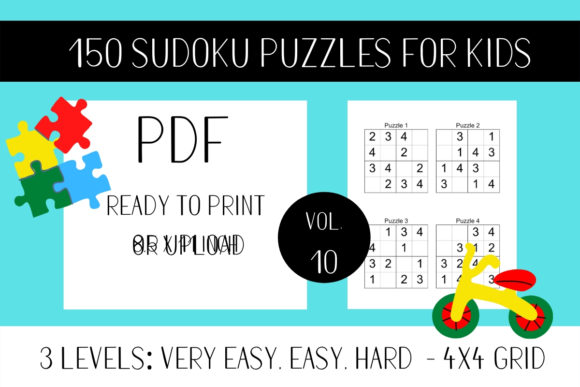
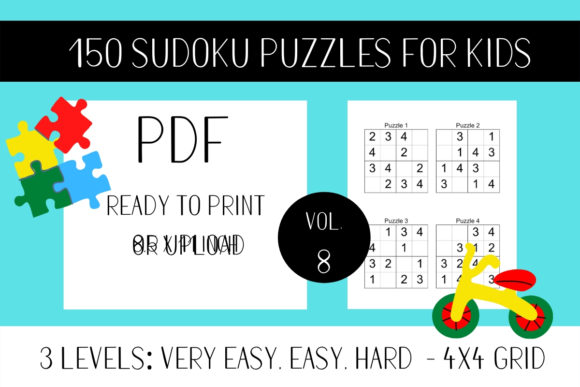
Integrating structured cognitive activities into early childhood development requires resources that balance engagement with appropriate challenge levels. The 150 Sudoku Puzzles for Kids Vol.8 serves as a specialized tool designed to bridge the gap between recreational play and foundational logic training. Unlike standard adult puzzle books, this volume is engineered specifically for developing minds, utilizing a 4x4 grid format that introduces algorithmic thinking without the frustration associated with traditional 9x9 matrices. For educators, homeschoolers, and parents seeking printable cognitive exercises, understanding the structural advantages and practical applications of this specific PDF resource is essential for maximizing its educational value.
The Pedagogical Value of the 4x4 Grid Format
The decision to utilize a 4x4 grid rather than the conventional 9x9 layout is a deliberate pedagogical choice rooted in cognitive load theory. Young learners and beginners often experience working memory overload when presented with too many variables simultaneously. The 4x4 format reduces the variable set to numbers one through four, allowing children to focus entirely on the logical relationships and rules of exclusion rather than arithmetic or complex scanning patterns.
This simplified structure acts as a scaffold. It teaches the core concept of Sudoku—that each row, column, and subgrid must contain unique symbols—in a digestible package. When using 150 Sudoku Puzzles for Kids Vol.8, instructors can observe students grasping the fundamental mechanics of constraint satisfaction problems. This early success builds the confidence necessary to eventually transition to larger grids. The 4x4 format is not merely a "baby version" of the game; it is a distinct logical exercise that reinforces pattern recognition and deductive reasoning skills applicable to mathematics and computer science fundamentals.
Optimizing Print Logistics for Classroom and Home Use
For professionals managing budgets or parents printing at home, the physical specifications of a puzzle book dictate its utility. This resource is formatted for standard 8.5″ x 11″ paper, ensuring compatibility with virtually all consumer and commercial printers without requiring scaling adjustments that could distort the grid lines. The layout efficiency is particularly notable for high-volume users such as teachers or camp counselors.
With four puzzles per page across 63 pages, the document maximizes ink efficiency and minimizes paper waste. This density provides substantial content without creating an unwieldy physical booklet. Furthermore, the inclusion of four answer keys per corresponding puzzle page streamlines the verification process. In a classroom setting, this allows for rapid peer-review or self-correction, turning the checking phase into an additional learning opportunity where students can analyze why a specific number placement was incorrect. The ready-to-print PDF format eliminates the need for software conversion, preserving the crispness of the grid lines which is vital for young users who are still developing fine motor control and visual tracking abilities.
Leveraging Three Difficulty Levels for Differentiated Instruction
One of the most significant challenges in educational resource selection is finding materials that accommodate varying skill levels within a single group. 150 Sudoku Puzzles for Kids Vol.8 addresses this through three distinct difficulty tiers. This stratification allows for differentiated instruction, a critical component in modern pedagogy.
- Beginner Level: Features grids with higher pre-filled cell counts, providing more anchor points for deduction. Ideal for first-time introductions or special education contexts requiring reduced cognitive friction.
- Intermediate Level: Reduces the number of given clues, requiring students to hold multiple possibilities in working memory and perform multi-step lookahead.
- Advanced Level: Challenges proficient solvers with minimal starting information, necessitating the use of elimination strategies and logical chaining rather than simple visual matching.
This progression supports a mastery-based learning approach. Students do not advance based on time spent but on demonstrated competency. Educators can assign specific tiers based on individual student assessments, ensuring that advanced learners remain engaged while those needing extra support are not discouraged. The variety also extends the lifespan of the PDF; a single purchase can serve a child or student cohort for months as they progress through the difficulty curve.
Digital Workflow and Resource Management
In an era of digital-first education, the format of instructional materials matters as much as the content. Receiving a single, consolidated PDF file offers distinct workflow advantages over web-based generators or physical books. Digital ownership ensures perpetual access without recurring subscription fees or shipping delays. For business owners running tutoring centers or after-school programs, this represents a fixed-cost asset with unlimited reproduction rights for internal use.
The PDF format also facilitates integration with Learning Management Systems (LMS). Teachers can upload specific pages directly to platforms like Google Classroom or Canvas, assigning homework digitally or preparing print packets in advance. Unlike interactive apps that may distract with animations or ads, a static PDF maintains focus on the cognitive task. Additionally, the digital nature allows for selective printing; an educator can extract only the "Advanced" pages for a gifted enrichment group or print double-sided copies to create compact booklets, further optimizing resource consumption.
Cognitive Development Beyond Entertainment
While often categorized as a game, the systematic solving of Sudoku puzzles engages executive functions that are critical for academic and professional success. Regular engagement with the puzzles in this volume stimulates the prefrontal cortex, enhancing skills such as:
- Working Memory: Holding potential number placements in mind while evaluating constraints.
- Inhibitory Control: Resisting the urge to guess and instead waiting for logical certainty.
- Cognitive Flexibility: Shifting strategies when a particular line of reasoning reaches a dead end.
- Sustained Attention: Maintaining focus on a single task until completion despite external distractions.
Research suggests that these non-verbal logic skills correlate strongly with mathematical aptitude and problem-solving capabilities in STEM fields. By incorporating 150 Sudoku Puzzles for Kids Vol.8 into a routine, adults are not simply keeping children occupied; they are facilitating neural development in areas that standardized testing often fails to address directly. The repetitive nature of the puzzles helps solidify these neural pathways, making logical analysis more automatic over time.
Practical Considerations for Implementation
To derive maximum benefit from this puzzle collection, users should consider the environment and methodology of implementation. While the 4x4 grid is accessible, it still requires explicit instruction for true novices. Adults should model the thinking process aloud, demonstrating how to scan rows and columns before expecting independent work. The physical act of writing numbers also plays a role; encouraging the use of pencils rather than pens promotes a growth mindset by framing errors as correctable steps in the learning process rather than permanent failures.
For commercial users or content creators looking to recommend resources, transparency regarding the scope is important. This volume contains 150 puzzles, which is a significant quantity but finite. Planning for supplementary activities or subsequent volumes ensures continuity in programming. Additionally, while the PDF is ready to print, users should verify their printer settings to ensure "Actual Size" or "100% Scale" is selected to maintain the intended 8.5″ x 11″ proportions. Distorted grids can inadvertently increase difficulty or cause visual strain, undermining the ergonomic design of the 4-puzzle-per-page layout.
Adapting Resources for Diverse Learners
The versatility of a printable PDF extends to its adaptability for neurodivergent learners. For students with dyscalculia or visual processing disorders, the clean, uncluttered aesthetic of a 4x4 grid is less overwhelming than dense text or complex illustrations. Educators can modify the resource physically by cutting individual puzzles out and mounting them on colored cardstock to reduce glare or provide tactile boundaries. The answer keys being located on separate pages (or organized distinctly) prevents accidental exposure to solutions, preserving the integrity of the challenge.
Furthermore, the non-linguistic nature of Sudoku makes this volume an excellent resource for ESL (English as a Second Language) learners or multilingual classrooms. Logic is universal; the rules of the grid do not require translation. This inclusivity broadens the applicability of 150 Sudoku Puzzles for Kids Vol.8 beyond native English speakers, making it a valuable asset in diverse educational settings where language barriers might otherwise limit participation in cognitive enrichment activities.
Evaluating Long-Term Engagement Strategies
Sustaining interest in logic puzzles requires balancing novelty with familiarity. The three-tier difficulty system inherent in this volume provides a built-in mechanism for long-term engagement. However, facilitators can enhance this by introducing meta-challenges. For example, timing solves for personal bests, creating collaborative pair-solving sessions, or using completed puzzles as components of a larger reward system can transform solitary practice into a dynamic social activity.
The high density of content—four puzzles per page across 63 pages—supports these varied approaches without exhausting the supply. A teacher could implement a "Puzzle of the Day" warm-up routine lasting an entire semester using only half the book, reserving the remainder for assessment or remediation. This longevity enhances the return on investment for both individual consumers and institutional buyers. Ultimately, the effectiveness of any educational tool lies in its consistent application. By understanding the specific structural benefits, logistical advantages, and cognitive targets of this ready-to-print collection, users can integrate it seamlessly into broader developmental frameworks, ensuring that the time spent solving translates into tangible intellectual growth.