Simple Lined Journal - KDP Interior: Streamlining Your Low Content Publishing Workflow
Building a sustainable portfolio on Amazon KDP requires more than just uploading generic files; it demands a systematic approach to asset management and production efficiency. The Simple Lined Journal - KDP Interior serves as a foundational component in this ecosystem, specifically engineered for publishers who prioritize speed without sacrificing technical compliance. Rather than viewing this interior as a standalone product, successful creators integrate it as a modular element within a broader publishing workflow. This resource eliminates the repetitive friction of formatting, allowing you to focus on niche research, cover design, and marketing strategy.
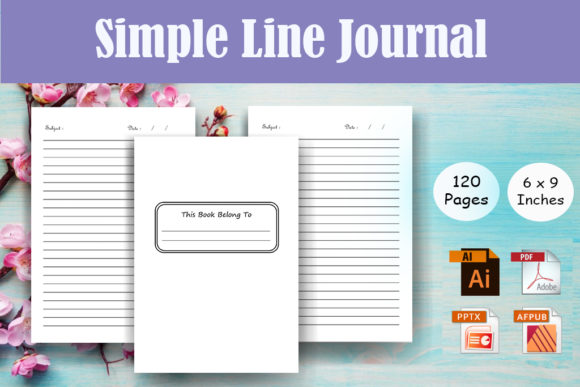
For professionals, educators, and entrepreneurs managing multiple titles, the value lies in the versatility of the included file formats. Having access to PDF, AI, AFPUB, and PPTX versions transforms a static interior into a dynamic asset. This flexibility ensures that whether you are launching a quick test title or customizing a premium journal for a specific corporate client, the technical groundwork is already validated and ready for deployment.
Technical Specifications and Platform Compliance
The most critical phase of any KDP project is ensuring the manuscript passes Amazon’s automated review process. Rejections due to margin errors, bleed issues, or resolution problems can stall momentum and impact account health. This Simple Lined Journal - KDP Interior has been pre-tested on KDP, significantly reducing the risk of upload errors. The 6×9 trim size is the industry standard for trade paperbacks, offering an optimal balance between portability and writing space that appeals to a wide demographic of adult users.
The 120-page count is strategically chosen for low-content publishing. It provides substantial perceived value to the customer while keeping printing costs low enough to maintain healthy royalty margins. High-resolution interiors ensure that lines appear crisp and professional in print, avoiding the pixelation or blurriness that often plagues amateur publications. When integrating this into your workflow, treat the provided PDF as your "master print" file. Because it has already undergone testing, you can bypass the lengthy proofing stage for standard lined journals, moving directly from selection to cover pairing.
Leveraging Multiple File Formats for Customization
While the ready-to-upload PDF facilitates rapid deployment, the inclusion of editable source files is what enables long-term business scalability. Understanding when and how to use each format is essential for an efficient production line.
Adobe Illustrator (AI) Files
The AI file is your primary tool for structural customization. If your market research indicates a need for a header, footer, or specific branding element on every page, this vector-based format allows for global changes across all 120 pages instantly. Use this file when creating series-specific interiors where consistent visual identity is paramount. Because vectors scale infinitely, you can also adapt this interior for different trim sizes in the future without losing line quality.
Affinity Publisher (AFPUB) Files
For publishers who prefer Affinity’s ecosystem or lack Adobe subscriptions, the AFPUB file offers professional-grade layout capabilities. This format is particularly useful for adding introductory pages, table of contents, or specialized sections before the lined content begins. It integrates smoothly into workflows where text-heavy front matter needs to be combined with the repetitive lined structure. Affinity Publisher’s master page functionality makes it easy to adjust margins or add watermarks across the entire document efficiently.
PowerPoint (PPTX) Files
Often overlooked in professional publishing, PowerPoint is a powerful tool for non-designers and marketers. The PPTX version of this Simple Lined Journal - KDP Interior lowers the barrier to entry for customization. Marketers and small business owners can quickly add logos, motivational quotes, or instructional text using familiar tools. This format is ideal for creating branded journals for corporate events, coaching programs, or educational workshops where design complexity is secondary to functional utility and brand alignment.
Integration into Pre-Launch Research and Planning
Efficient publishers do not select interiors randomly; they match them to validated market needs. Before utilizing this Simple Lined Journal - KDP Interior, conduct keyword research to identify gaps in the 6×9 lined journal category. Look for niches where standard lined paper is insufficient but full custom interiors are unnecessary. Examples include gratitude journals, meeting notebooks for specific professions, or academic composition books.
During the planning phase, assess the compatibility of this interior with your intended cover designs. The 6×9 dimension dictates specific spine width calculations based on the 120-page count. By standardizing your interior assets, you can create cover templates that align perfectly with this specification. This pre-alignment prevents costly rework later. Keep a spreadsheet tracking which niches utilize this specific interior variant to avoid market cannibalization and to identify opportunities for bundling or series expansion.
Execution Strategies During Production
When moving from planning to active creation, organization becomes the primary driver of profitability. Establish a standardized folder structure for your KDP projects. Within each project folder, maintain subdirectories for "Source," "Print Ready," and "Marketing Assets." Store the original AI, AFPUB, and PPTX files in the Source folder to preserve your ability to make future edits. Only place the final, flattened PDF in the Print Ready folder to prevent accidental uploads of editable drafts.
Batch processing is highly effective with this asset. Instead of creating one journal at a time, select five to ten related niches that share the same interior requirements. Customize the source file once with niche-specific elements (such as a unique title page or subtle watermark), export the variations, and queue them for cover design. This assembly-line approach maximizes the utility of the Simple Lined Journal - KDP Interior and reduces the cognitive load associated with switching between different technical specifications.
Quality control should remain rigorous even with pre-tested files. Always download the digital proof from KDP before approving publication. Check specifically for the alignment of lines relative to the gutter margin, as binding thickness can vary slightly between print facilities. Verify that any custom additions made via AI or AFPUB have not shifted the safe zone boundaries. This final verification step takes minutes but protects your brand reputation from negative reviews regarding formatting defects.
Post-Publication Asset Management and Iteration
The lifecycle of a KDP interior extends beyond the initial upload. Monitor sales data and customer feedback to inform future iterations of this Simple Lined Journal - KDP Interior. If customers consistently mention that the lines are too faint or too dark, return to the AI or AFPUB source file to adjust stroke weight. If a particular niche performs exceptionally well, consider creating complementary interiors (such as dot grid or graph paper) using the same base template to build a cohesive brand family.
Repurposing is another key post-publication strategy. The high-resolution nature of these files means they can be adapted for other platforms or products. Consider extracting individual pages to create printable digital downloads for Etsy or Teachers Pay Teachers. The PPTX version can be converted into a lead magnet for email list building, offering a free 10-page sample journal to drive traffic to your paid KDP listings. This multi-channel approach extracts maximum ROI from a single asset purchase.
Optimizing Workflow Efficiency and Consistency
Consistency builds trust with buyers and streamlines backend operations. By adopting this Simple Lined Journal - KDP Interior as a standard component of your catalog, you reduce decision fatigue. You no longer need to evaluate margin settings or line spacing for every new title. This mental bandwidth can be redirected toward higher-value activities like advertising optimization, A/B testing covers, and expanding into adjacent categories.
For teams or virtual assistants, standardized assets are invaluable. Create a standard operating procedure (SOP) document that references these specific files. Instruct team members on which file format to use for specific tasks and where to locate the pre-tested PDFs. This reduces training time and minimizes errors caused by inconsistent formatting practices. The availability of multiple formats ensures that regardless of your team's software preferences or skill levels, there is an accessible entry point for contributing to the production pipeline.
Ultimately, success in low-content publishing is a function of volume multiplied by quality. This interior provides the quality baseline necessary to scale volume sustainably. It bridges the gap between amateur experimentation and professional publishing operations, offering the technical reliability and creative flexibility required to compete in mature markets. By treating this download not merely as a file but as a integrated system component, you position your business for efficient growth and long-term resilience.