Evaluating the KDP Goal Setting Journal Interior for Practical Publishing
Creating a successful low-content book on Amazon KDP requires more than just an attractive cover; the interior must provide genuine utility to the end user. The KDP Goal Setting Journal Interior is a specialized template designed to address this specific need by offering a structured framework for personal development. Rather than providing generic lined pages, this 75-page resource guides users through a psychological and tactical process of goal achievement. For publishers, entrepreneurs, and creators looking to expand their catalog with high-value assets, understanding the functional depth of this interior is essential for determining its viability in a competitive marketplace.
Structural Integrity and Page Composition
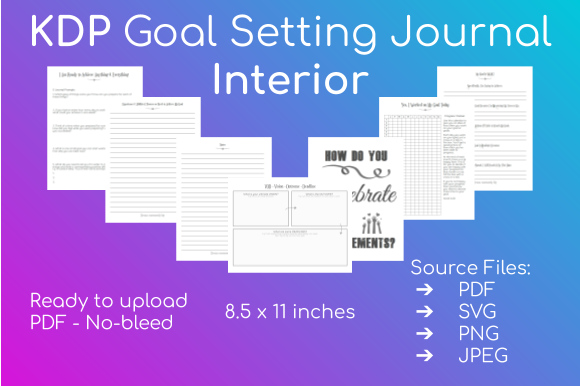
The architecture of this journal distinguishes it from standard notebooks. It is formatted at 8.5x11 inches with no bleed, which simplifies the printing setup and reduces potential formatting errors during the KDP upload process. The 75-page count is deliberate, structured specifically to accommodate five distinct goals. This limitation is a strength rather than a weakness; it prevents the book from becoming overwhelming and encourages focused, deep work rather than superficial list-making.
Each goal section utilizes a repeating sequence of pages that moves the user from abstract desire to concrete planning. The inclusion of specific frameworks like VOD (Vision, Outcome, Deadline) provides a proprietary feel that adds perceived value over generic planners. Furthermore, the integration of SMART goal criteria ensures that the journal aligns with established productivity methodologies. For the publisher, this means the product appeals to an audience already familiar with professional development concepts, reducing the friction required to market the book effectively.
Key Functional Elements
- VOD Framework: Helps users articulate the vision, define the specific outcome, and set a hard deadline, creating immediate accountability.
- Obstacle Identification: Dedicated prompts for internal and external barriers force users to anticipate challenges before they arise.
- Five Journal Prompts: Structured questions that dig into the emotional and logical "why" behind the objective.
- Progress Tracker: A visual or tabular method to monitor advancement, which is critical for user retention and satisfaction.
- Inspirational Quotes: Strategically placed to maintain engagement without consuming excessive writable space.
Technical Specifications and Production Quality
From a production standpoint, the KDP Goal Setting Journal Interior is optimized for efficiency. The file is delivered as a print-ready PDF at 300 DPI, ensuring crisp text and clean lines on physical paper. Low-resolution interiors are a common failure point in KDP publishing, leading to negative reviews regarding blurriness or pixelation; this template mitigates that risk entirely. The no-bleed specification is particularly advantageous for new publishers or those who want to avoid the complexities of trimming margins. It allows for safer content placement and reduces the likelihood of rejection during Amazon’s automated review process.
The package also includes source files in PDF, SVG, PNG, and JPEG formats. This multi-format delivery is significant for long-term asset management. While the ready-to-upload PDF serves immediate needs, the SVG and PNG files allow for customization. Publishers can modify fonts, adjust layout spacing, or rebrand elements to create a unique product derivative. This flexibility transforms a single purchase into a foundational asset for a broader series, enhancing the return on investment and allowing for niche-specific adaptations.
Audience Alignment and Market Fit
Understanding who will actually use this journal is paramount for effective positioning. This interior is not designed for casual doodling or unstructured diary entries. It targets adults aged 20–50 who are actively engaged in self-improvement, career advancement, or business building. Professionals, freelancers, and small business owners constitute the primary demographic because they require structured tools to manage complex objectives. The inclusion of obstacle analysis and SMART criteria resonates with individuals who have moved beyond basic to-do lists and are seeking systemic change.
Educators and coaches may also find this interior valuable as a supplementary tool for students or clients. The guided nature of the prompts reduces the cognitive load for users who struggle with blank-page syndrome. However, publishers should note that the specific focus on five goals makes this less suitable for annual planning or daily habit tracking. It is a project-based tool. Marketing copy should reflect this distinction to attract the right buyers and manage expectations, thereby protecting review ratings.
Practical Use Cases
- Career Pivots: Professionals mapping out a transition to a new industry can use the five sections to break down skill acquisition, networking, certification, portfolio building, and job hunting.
- Entrepreneurial Launches: Freelancers can dedicate sections to product development, marketing strategy, legal setup, financial systems, and client acquisition.
- Creative Projects: Authors or artists can structure the completion of a manuscript or exhibition, focusing on drafting, editing, publishing, promotion, and sales.
- Coaching Programs: Life or business coaches can bundle this journal with their services as a tangible workbook for client accountability.
Customization Potential and Creative Flexibility
While the ready-to-upload PDF offers speed to market, the true value for serious publishers lies in customization. The provision of source files allows creators to adapt the KDP Goal Setting Journal Interior to specific micro-niches. For example, a publisher targeting real estate agents could modify the prompts to focus on listing goals and closing ratios. A fitness-focused version might adjust the obstacle section to address physical plateaus and dietary compliance. This ability to pivot the core content without redesigning the entire layout from scratch significantly accelerates product development cycles.
Even without extensive design skills, users can leverage the included PNG and JPEG assets to create complementary marketing materials or digital versions. Consistency between the physical journal and digital lead magnets strengthens brand recognition. However, publishers should exercise restraint when modifying the template. The existing flow has been designed with user psychology in mind; drastic alterations to the page order or prompt structure could inadvertently reduce the journal's effectiveness. Testing modified versions with a small focus group before full publication is a recommended best practice.
Limitations and Considerations for Publishers
No template is universally perfect, and objective evaluation requires acknowledging limitations. The most notable constraint is the absence of a front cover. Publishers must source or design a cover separately, ensuring it matches the 8.5x11 no-bleed specifications. This adds an extra step to the workflow and requires additional design competency. Additionally, the fixed structure of five goals may feel restrictive to some users who prefer open-ended planning. While this structure is intentional, it should be clearly communicated in the book description to avoid returns from customers expecting a traditional diary.
Another consideration is market saturation. Goal-setting journals are a popular category on KDP. Simply uploading the template without differentiation is unlikely to yield significant results. Success depends on how well the publisher integrates this interior into a cohesive brand strategy. Keywords, categories, and advertising must be tailored to the specific sub-niche the journal serves. The template provides the vehicle, but the publisher must still navigate the route. Relying solely on the template's inherent quality without strategic marketing is a common pitfall.
Assessing Long-Term Value and ROI
When evaluating the KDP Goal Setting Journal Interior as a business asset, consider both immediate revenue potential and long-term portfolio growth. The print-ready quality and comprehensive source files reduce technical overhead, allowing publishers to focus on marketing and niche research. The structured content supports higher price points compared to simple lined journals, potentially improving royalty margins per unit. More importantly, the educational value embedded in the pages fosters customer loyalty; users who achieve results with a journal are more likely to seek out other products from the same creator.
For educators, coaches, and service providers, this journal can serve as a lead generator or value-add that extends beyond direct KDP sales. The ability to repurpose the content for workshops, courses, or digital downloads multiplies the utility of the initial investment. Ultimately, this interior is best suited for publishers who view low-content books as part of a broader ecosystem rather than isolated income streams. It offers a professional foundation that balances ease of use with sufficient depth to satisfy discerning adult learners and achievers.